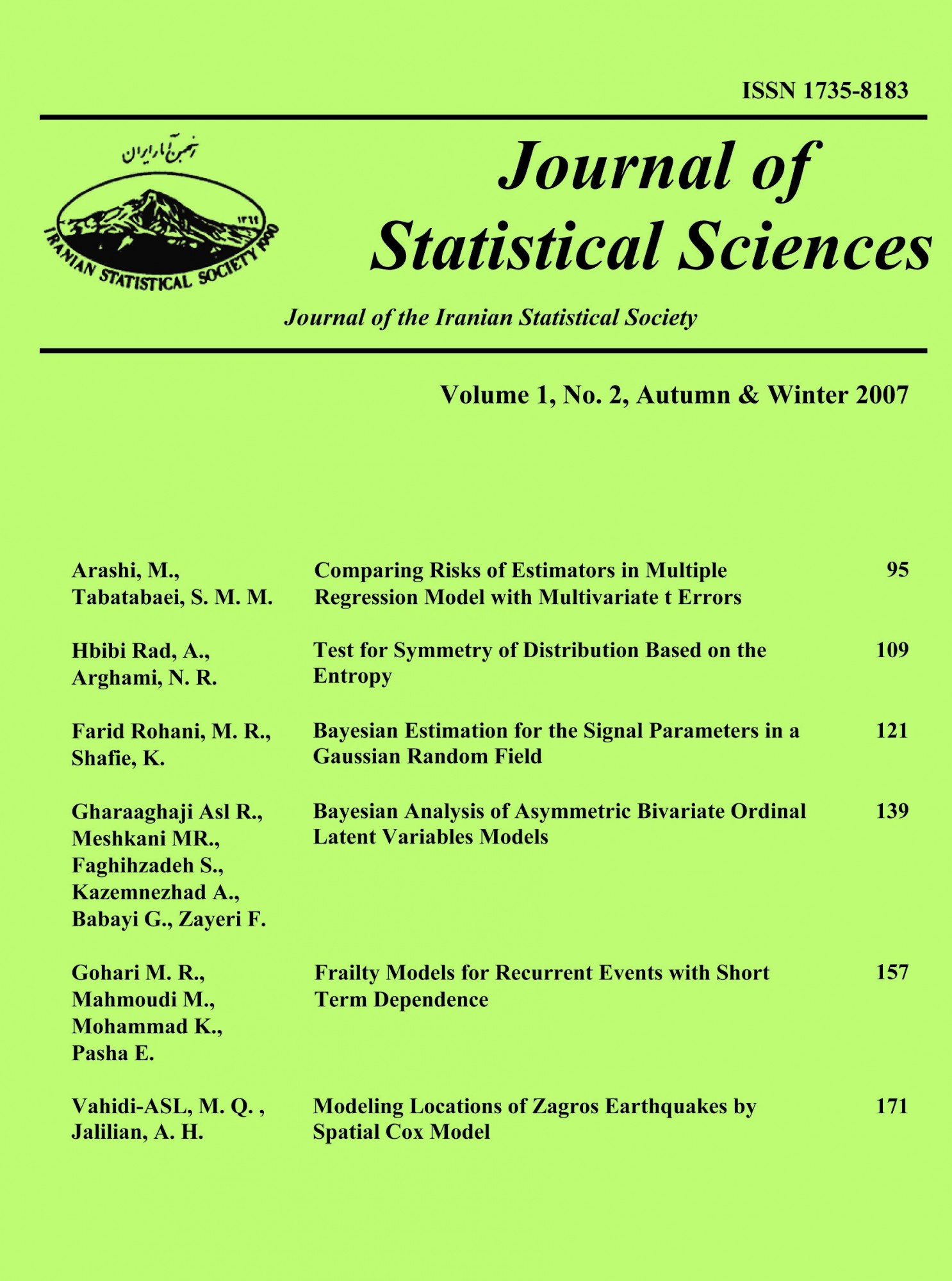
Journal of the Iranian Statistical Society

Journal of the Iranian Statistical Society

JIRSS is the official journal of the Iranian Statistical Society. This open-access peer-review journal provides an international forum for refereed original research work in Probability, Mathematical Statistics, and Statistical Methods. Prime importance is given to significant theoretical developments and to innovative applications of statistical methodology. Manuscripts submitted to the JIRSS must be in English and present original unpublished work and should not be under consideration for publication elsewhere. The JIRSS is published in one volume of two issues a year and appears in June and December. The journal follows the instruction of Committee on Publication Ethics (COPE).

About the Journal

Publisher: Iranian Statistical Society

Editor-in-Chief: Abdolrahman Rasekh

Director-in-Charge: Ahmad Parsian

Managing Editor: Mohammad Reza Akhoond

E-mails: JIRSS@irstat.ir

Website: https://jirss.irstat.ir/

DOI: 10.22034/JIRSS

Review Time: 4-8 Weeks

Frequency: Twice in Year

Publication Type: Electronic

Open Access: Yes

Policy: Double Blind Peer-Reviewed

Language: English 

Abstracts Available in: English 

Article Processing Charges: No

ISSN (Print): 1726-4057

ISSN (Online): 2538-189X

Journal Impact Factor: 0.1 (2025)

5-Year Journal Impact Factor: 0.6 (2025)

Indexed and Abstracted  in: Web of Science Core Collection (ESCI), Scopus, SCImago Journal & Country Rank,  Islamic World Science Citation center (ISC), Crossref, ROAD, WIKIDATA, sudoc, OpenAlex, EZB, ZDB, Magiran, Scientific Information Database (SID), Iran Ministry of Science, Research and Technology, Google Scholar

The JIRSS adheres to the guidelines of the Committee on Publication Ethics (COPE) and follows its principles on how to deal with acts of misconduct, thereby committing to investigate allegations of misconduct in order to ensure the integrity of research.

It should be noted that while the journal follows COPE's guidelines, it is not a formal member of COPE.

Journal of the Iranian Statistical Society (JIRSS) utilizes Plagiarism Detection Software (iThenticate) for checking the originality of submitted papers in the reviewing process. 

Current Issue: Volume 25, Issue 1, June 2026, Pages 1-148 

Keywords Cloud

  • Order statistics
  • Maximum likelihood estimation
  • Monte Carlo Simulation
  • Exponential Distribution
  • Entropy
  • record values
  • Simulation
  • hazard rate order
  • Weibull distribution
  • Copula
  • em algorithm
  • Records
  • recurrent events
  • Characterizations
  • geometric distribution
  • Quantile Function
  • moments
  • COVID-19
  • Logistic regression
  • prediction
  • Parameter estimation
  • wavelets
  • Admissibility
  • censored data
  • model selection
  • Auxiliary Information
  • Coverage probability
  • Cumulative residual entropy
  • Asymptotic Normality
  • finite mixture model
  • likelihood ratio order
  • simple random sampling
  • Stochastic Orders
  • Majorization
  • Length-biased data
  • usual stochastic ordering
  • hazard function
  • Residual Lifetime
  • Mean squared error
  • Gibbs Sampling
  • ‎EM algorithm‎
  • Relative efficiency
  • Stochastic order
  • Kullback-Leibler divergence
  • MLE
  • Beta distribution
  • Reliability
  • ‎reliability‎
  • proportional hazard rate model
  • Change-Point Detection
  • Akaike Information Criterion
  • Saddlepoint Approximation
  • Binomial thinning operator
  • Binary search tree
  • Mean residual life function
  • likelihood ratio
  • Markov Chain
  • Linear regression model
  • conditional median predictor
  • Bivariate distribution‎
  • Rayleigh distribution
  • Time Series
  • best unbiased predictor
  • Shrinkage
  • Characterization
  • exponentiality test
  • Confidence interval
  • Strong consistency
  • Bandwidth
  • linear regression
  • Archimedean copula
  • maximum likelihood predictor
  • Goodness of Fit Tests
  • Divergence measure
  • permutations
  • Progressive Censoring
  • limiting distribution
  • Classification
  • variable selection
  • Asymptotics
  • quickselect
  • mixture models
  • Regularization
  • survival function
  • preliminary test estimator
  • Fisher information
  • Information Theory
  • Maintenance
  • kernel smoothing
  • interval parameter
  • Generalized likelihood ratio test
  • nonparametric estimation of derivative of a density
  • Jack polynomials
  • Coherent System
  • Goodness of Fit
  • Renyi information
  • Data Analysis
  • shrinkage estimation
  • zonal polynomials
  • Pareto distribution
  • Markov property
  • Neural network
  • dominance
  • Analysis of algorithms
  • half logistic distribution
  • Clustering
  • Shannon Entropy
  • power of the test
  • Generalised hypergeometric functions
  • optimality
  • ranked set sampling
  • observed information matrix
  • imputation
  • Reversed Hazard Rate Order
  • Method of moments
  • consistency
  • hazard rate
  • Mean-variance mixture distribution
  • real normed division algebras
  • Finite alphabet
  • Posterior probability
  • Characteristic Function
  • Baranchik Type Estimators
  • Exponential Family
  • Birnbaum-Saunders
  • Bayesian estimation
  • quasi-likelihood
  • Elliptically contoured distribution
  • functional equations
  • highest conditional density
  • strong mixing
  • Approximation
  • Fisher information matrix
  • tracking interval
  • Characterizations‎
  • estimation
  • ‎Maximum Likelihood Estimation‎
  • multicollinearity
  • series system
  • Exchangeability
  • information matrix
  • discrete distributions
  • Renyi entropy
  • Hazard rate function
  • location model
  • Design optimality criteria
  • Infinite-time Ruin Probability
  • Anderson-Darling Statistic
  • Modified Maximum Likelihood Estimator
  • ‎Fisher exact test‎
  • missing at random
  • perfect and partial repairs
  • Walker\'s inequality‎
  • Bivariate model‎
  • Symmetry testing
  • ‎ ‎functions of random variables‎
  • ‎Order‎ ‎statistics‎
  • Relative Ageing Orders
  • Bregman divergence
  • Likelihood Cross-validation
  • Goodness of Fit Testing
  • ‎Conditional expectations
  • multivariate stochastic order
  • Parallel Systems
  • Partition Analysis
  • maternal healthcare
  • ‎Maximum likelihood estimator‎
  • Parameters Estimation
  • Cumulative residual extropy
  • ‎Moments‎
  • Shiryaev’s Loss Function
  • residual lifetime and univariate likelihood ratio order
  • ‎Prediction‎
  • Frequency response function
  • Error Rate
  • exponential convergence
  • kernel density estimator
  • ‎Short tails‎
  • Autoregressive Process
  • Right-Censored Data
  • Generalized Family
  • Two Parameter Estimation
  • Digital trees
  • orthogonalization
  • Vuong\'s Test
  • Test of Birnbaum-Saunders
  • Lin-Wong Divergence
  • branching random walk
  • Discrete mean residual life function
  • generalized variances
  • Bayesian Premium
  • health insurance
  • Response surface model
  • mclust
  • Cycles
  • Bivariate Inverted Kumaraswamy Distribution
  • Elliptical Distributions
  • Beta-Weibull-Logarithmic distribution
  • ‎(n-k+1)-out-of-n system
  • Markov Chain Monte Carlo method